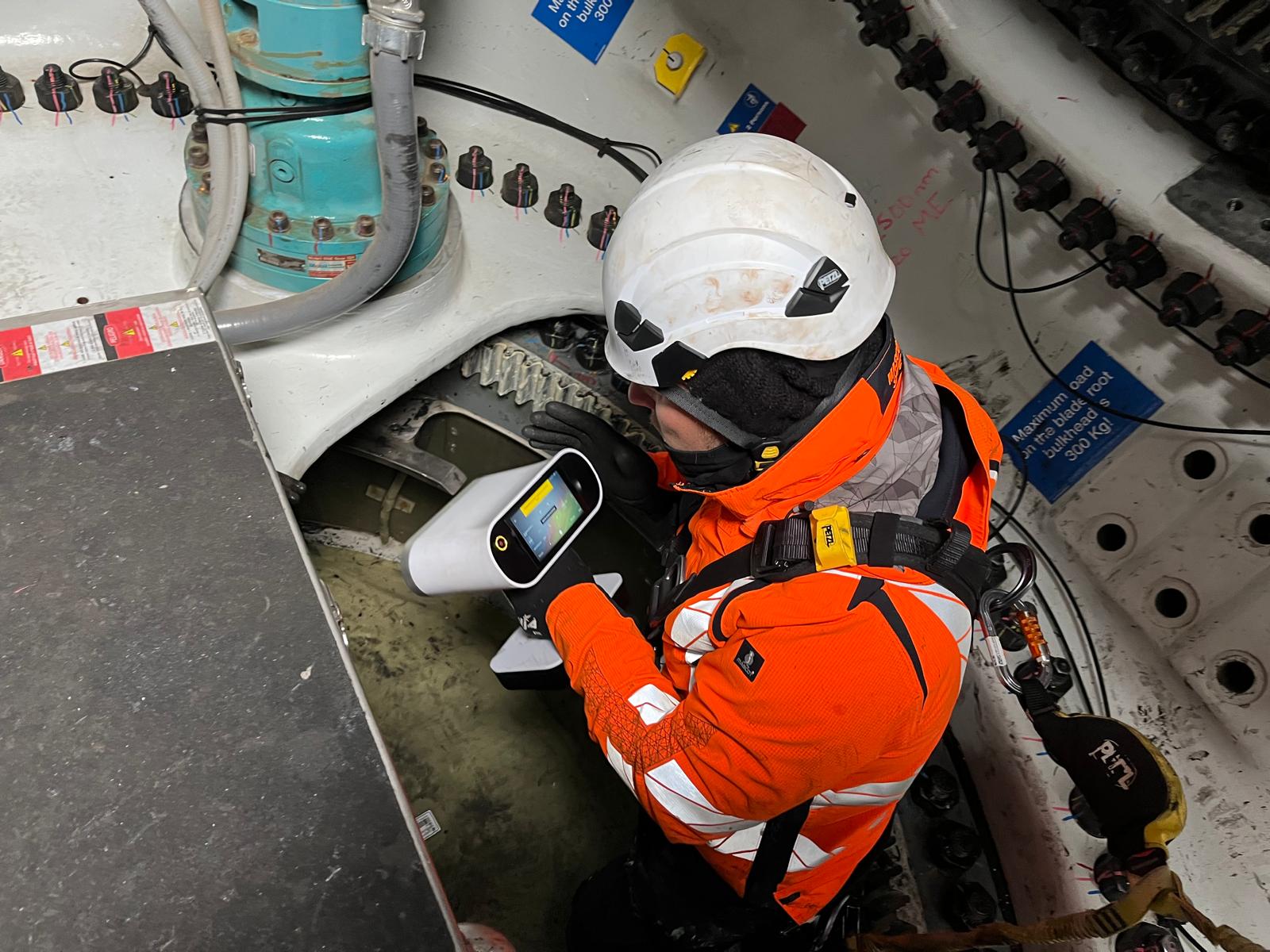
Through 3D digitization, the company turns industrial plants into digital archives and inspects machine components without having to visit the facilities.
The countless advantages offered by virtual reality have made its use increasingly necessary in different fields, particularly in engineering. Monitoring production at industrial plants, inspecting machine components or carrying out maintenance without having to visit the facilities is now possible thanks to Dogram. Through 3D digitization, the Asturian company transfers physical reality to a computer environment, not only helping to reduce costs but also making work easier. “In this way, it is possible to prevent risks, improve plans and drawings, assess the incorporation of new structures, add equipment, among many other tasks,” explains Carlota Abello, CEO of the company.
As specialists in metrology and dimensional inspection, Dogram is also able to digitize entire facilities, optimize and increase the flexibility of industrial processes, monitor the manufacturing of high-value equipment and even contribute to the preservation and dissemination of cultural heritage. “The scope of our work is very broad because we can cover a wide variety of activities, but ultimately, we make engineering projects easier to carry out,” Abello explains.
Its origins
The idea emerged in the summer of 2013. After realizing that companies were increasingly interested in embracing modernization and that this need was largely unmet, they decided to take action. “We saw that our professional knowledge and experience, together with the idea of improving 3D digitization techniques, could provide value to other people, organizations and companies,” says the company’s CEO, who explains that by the end of that year the company had already been incorporated.
Although there is some competition in this field in Spain, since its creation Dogram has attracted clients such as Repsol, Cepsa, Thyssenkrupp and TSK, among many other renowned companies. “Most of our clients are currently in the industrial sector, with two main types of customers. On the one hand, there are large industrial facilities and engineering firms in the oil & gas, steel, nuclear and renewable energy sectors. On the other hand, there are companies involved in the manufacture of components, equipment and machinery,” Abello explains.
Along the same lines, the CEO points out that “our main source of revenue comes from companies in Spain, but we have already carried out international projects in Germany and even the United States. In those cases, we have done so alongside our Spanish clients. However, it is true that we now also have a client from outside Spain.” At the same time, as the company grew, it became established in Asturias as “a complement to the region’s industrial hub.”
But getting to this point has required the multidisciplinary team at Dogram to undergo continuous development and training. “We improve our knowledge of technologies and working methodologies.” They have also strengthened their relationship with clients. “We approach each project independently. We analyze in detail what the actual need is, what the deliverable will be used for once we have completed our work, assess how it may impact the client’s workflows and whether they will subsequently be able to independently explore and make continued use of what they have received,” she emphasizes.
Ultimately, “we get heavily involved and prioritize quality over the number of projects. This, combined with our experience, technical expertise, and the professionalism and commitment with which we carry out all our work, has resulted in 90% of our clients coming back to us.” This expertise and commitment will allow the company to consolidate the growth it has achieved in recent years. It will also help it achieve its goal of “becoming a leading company in metrology and 3D digitization in Spain and further increasing our international presence.”
Support from IDEPA
The support received from the Instituto de Desarrollo Económico del Principado de Asturias (IDEPA) has also helped Dogram reach this point. “They have supported us since the creation of the company by granting us funding to get the business up and running.” From that point onwards, “the support has been continuous, both through grants for the development of innovation projects and through funding for the acquisition of technological equipment, which has enabled us to improve our range of services,” Abello acknowledges.
More specifically, the Centro Europeo de Empresas e Innovación (CEEI) of the Principality of Asturias helped them define their business model and prepare their business plan. Subsequently, they provided personalized business advice for the processing and launch of the company through the PAE point of service, with Dogram establishing its registered office and offices from the outset at the CEEI Business Incubator in the Technology Park.
In addition, Dogram received support in seeking both public and private financing and participated in numerous business growth support programmes and initiatives, including Se busca CEO to complete its team, the CREA&TECH Programme supporting the creative industries, Open Innovation programmes, sector forums and networking events such as the Foro Metal, as well as cooperation meetings with leading companies and other key stakeholders. The company is also an active member of the CEEI Asturias EBT community.
Asturgar provided the company with a guarantee for an advance payment of a grant, while Asturex enabled Dogram to participate in the export initiation programme and the 2018 cooperation forum. Through the Sociedad Regional de Promoción del Principado de Asturias (SRP), the company also received a €150,000 participating loan.
All of these initiatives have supported Dogram’s development and contributed to its recognition with the Empresa Innovadora de Base Tecnológica (Innovative Technology-Based Company) designation, owned by ANCES.
Source: La Voz de Asturias